CAM mode
Import Gerber, Excellon, ODB++ and DXF data, arrange the PCB project, select tools and generate machining programs for isolation routing, copper clearing, drilling, board cutout and other documented operations.
Integrated CAM preparation and CNC control software developed for TELENET PCB prototyping machines.
PhCNC combines CAM preparation and CNC control for compatible TELENET and legacy AccurateCNC PCB prototyping systems. It is supplied with compatible machines and PhCNC-based control systems, not as standalone software.
Import Gerber, Excellon, ODB++ and DXF data, arrange the PCB project, select tools and generate machining programs for isolation routing, copper clearing, drilling, board cutout and other documented operations.
Execute generated programs, control the configured machine and switch between CAM preparation and machine operation. Camera/microscope hardware supports project positioning, measurement, inspection and fiducial-registration workflows.
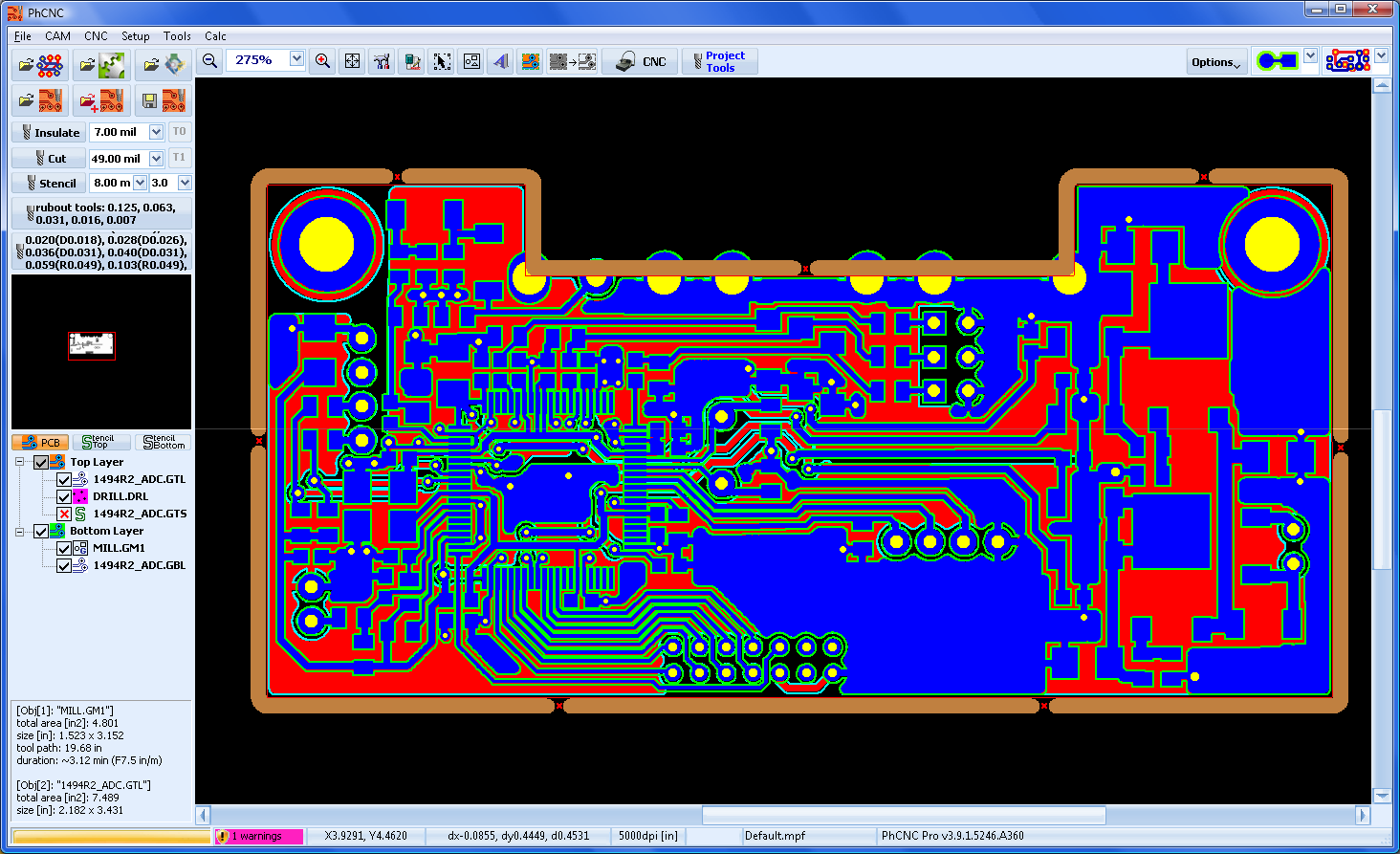
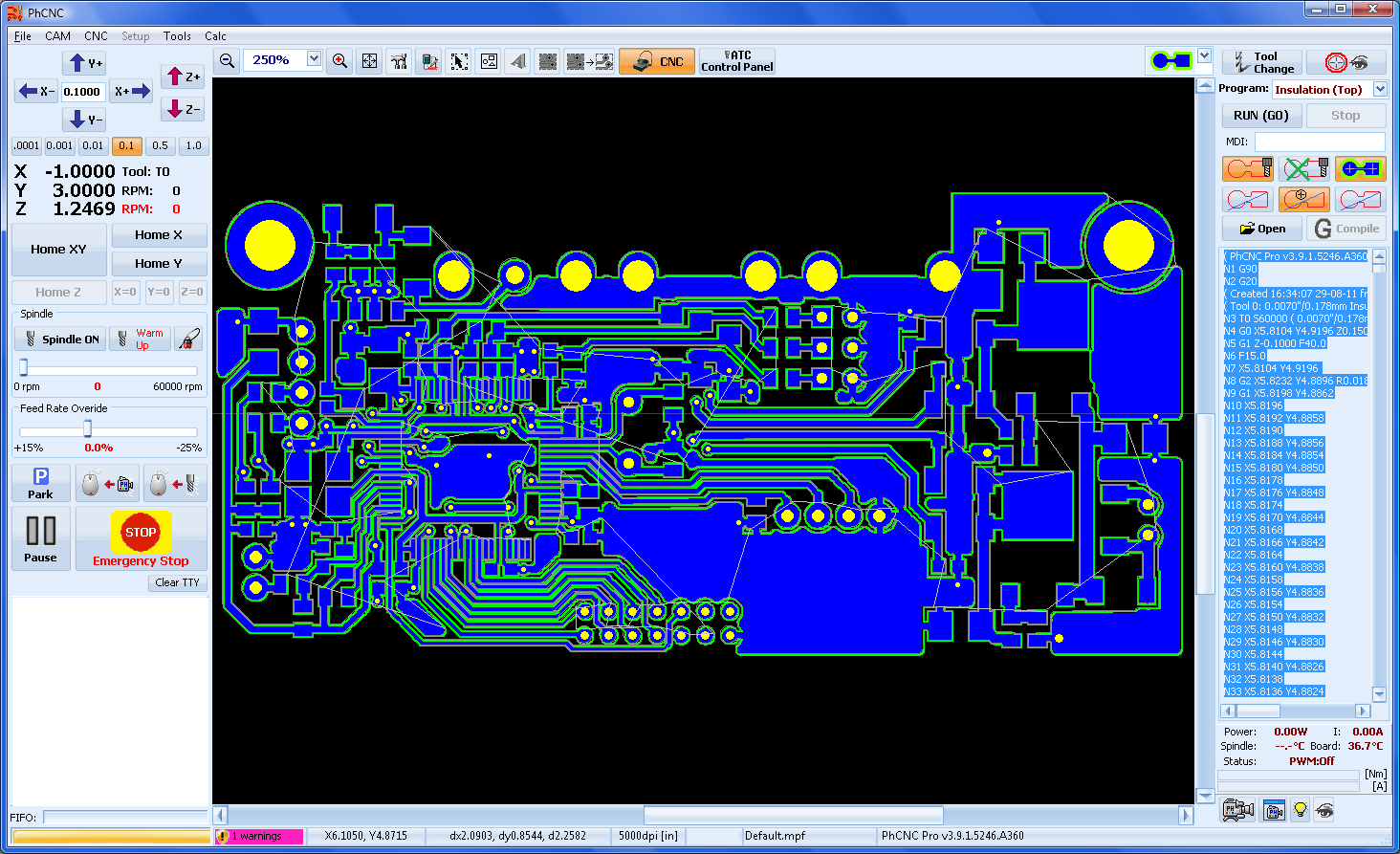
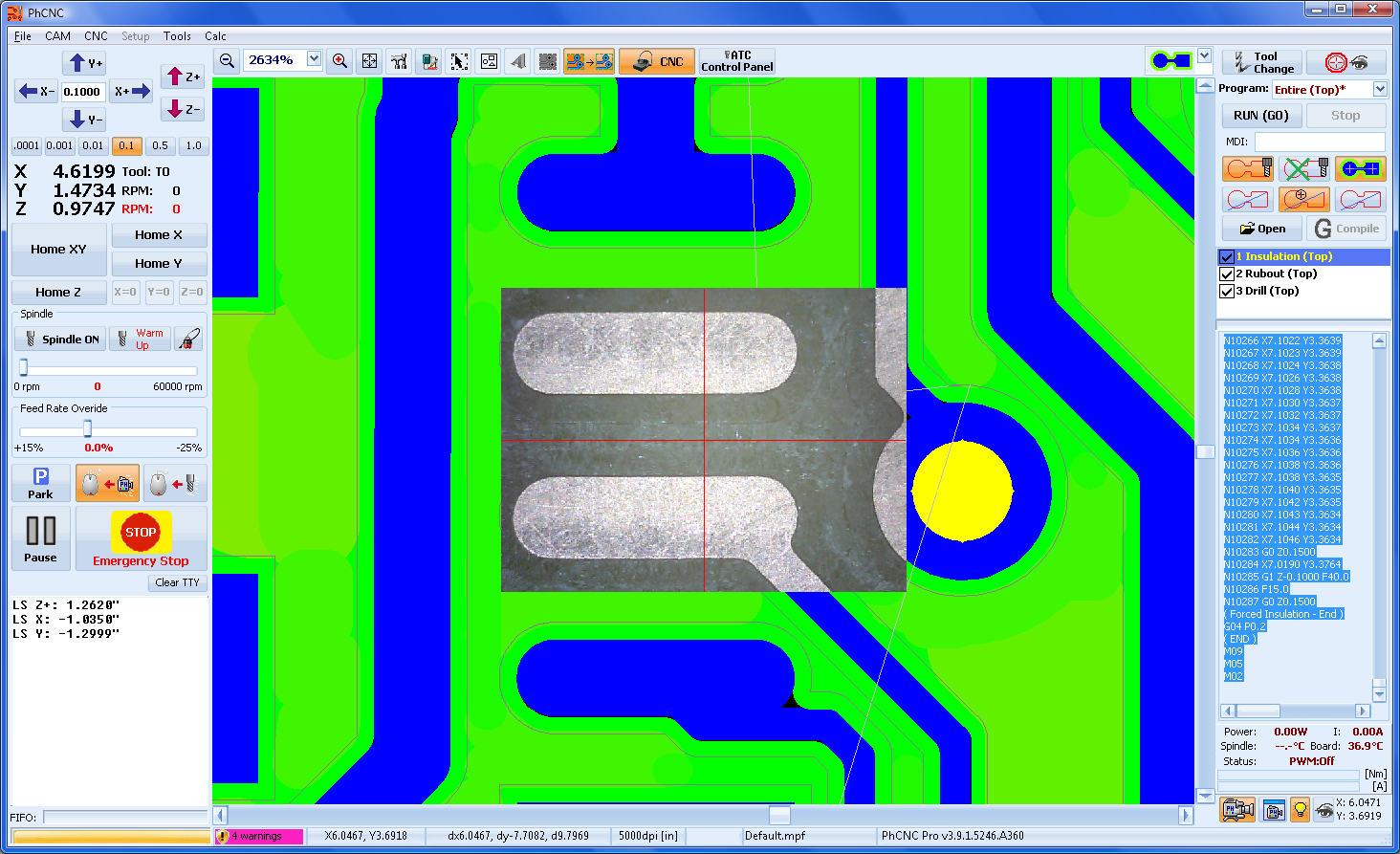
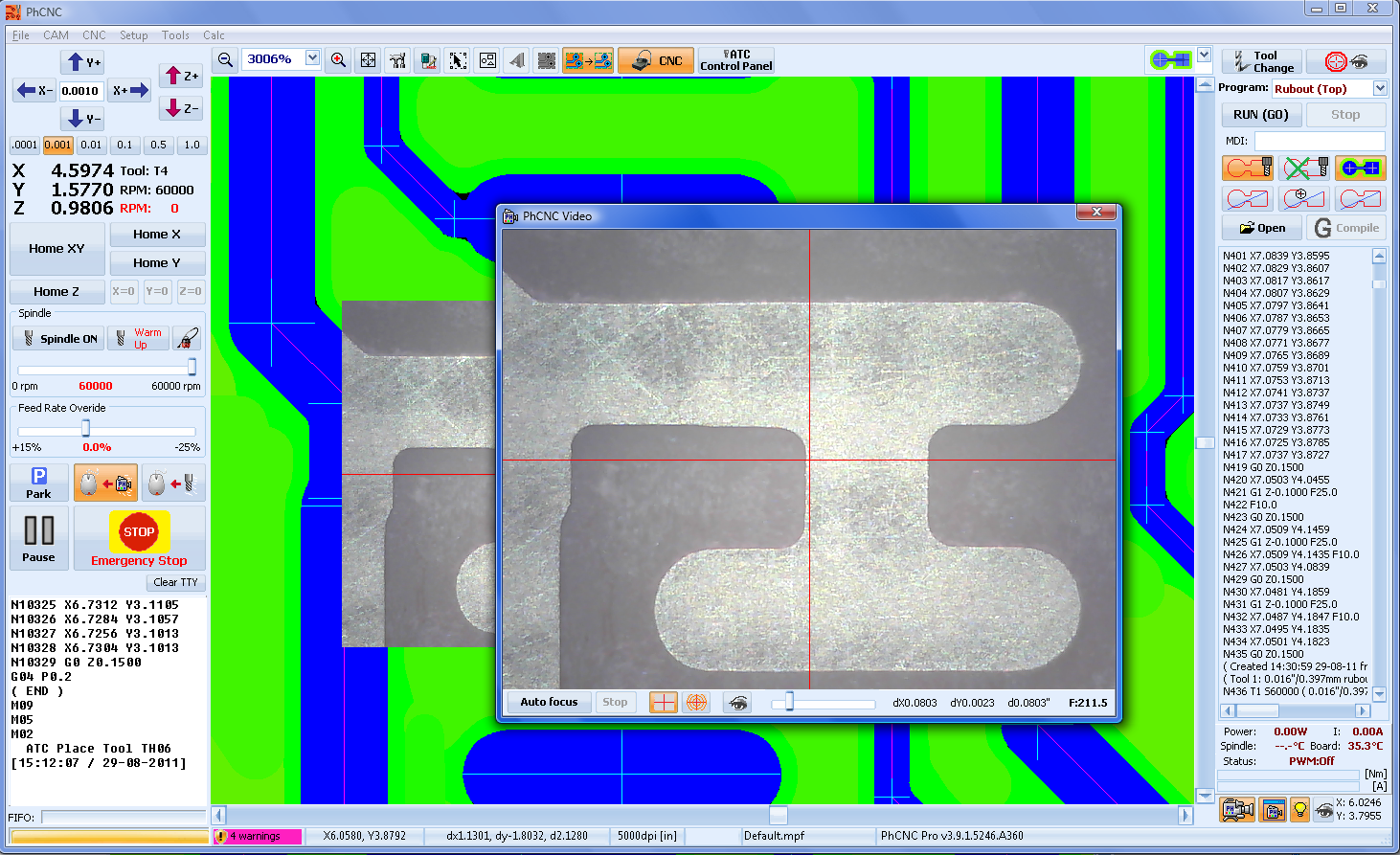
A software demonstration is available on the PhCNC Software Demo page. The demo simulates a legacy machine configuration and does not represent a standalone PhCNC product license.
The PhCNC CAM environment is common to all supported machine models and uses the same core CAM technology as PhCNC LSSE and PhCNC LSSE HD.
| Capability | Description |
|---|---|
| Import and project preparation | |
| File import | Import Gerber RS-274X, ODB++, Excellon and AutoCAD DXF data generated by virtually any PCB CAD system. |
| ODB++ projects | Import complete ODB++ jobs from directories and supported compressed packages, with automatic recognition of relevant PCB layers and project structure. |
| ODB++ Bridge - Zero Clicks | Automatic native ODB++ transfer from KiCad, Altium Designer, EasyEDA Pro Desktop, OrCAD X / Allegro, Autodesk Fusion, CADSTAR, DipTrace and Siemens PADS Pro Layout. Start the Bridge command in your PCB CAD; PhCNC imports the result in CAM mode with no additional import clicks. |
| Manual Pick & Place Helper | Interactive assistant for manual PCB assembly. Select one or multiple components and PhCNC shows their locations with flashing highlights while displaying designator, footprint and description. Pin 1 is indicated when imported ODB++ or Gerber + Pick & Place data contains the required information. |
| Project workflow | Create, load, save and combine reusable PhCNC projects. |
| Multiple designs | Import and arrange multiple independent PCB designs in one project. |
| Machining window | Process a selected region or divide projects that are larger than the available machining area into sections. |
| Editing, grouping and panelization | |
| Object editing | Select, move, rotate, copy, clone and delete project objects. |
| Grouping | Create nested groups without an arbitrary one-level grouping restriction. |
| Cloning and panelization | Clone and arrange PCB objects to create production panels. |
| Undo and Redo | Provide 32 levels of Undo and Redo for supported project-editing operations. |
| Routing tabs | Add or remove contour-routing tabs interactively by pressing Ctrl+T while the mouse pointer is positioned over a cutting contour. |
| Isolation and copper processing | |
| High-performance geometry engine | Efficiently process complex Gerber designs containing thousands of tracks, polygons and aperture macros without requiring conversion into G36/G37 polygons merely for acceptable performance. |
| Internal calculation resolution | Use 1 nm internal geometric calculation resolution. This value describes internal calculations, not guaranteed physical machining accuracy. |
| Isolation routing | Generate isolation toolpaths using up to 8 different isolation tools. |
| Multi-tool isolation strategy | Use larger tools whenever possible and reserve smaller, more expensive tools for areas where their diameter is required, reducing machining time and small-tool wear. |
| Copper rubout | Remove unwanted copper using up to 8 different rubout tools. |
| DRV and Forced Insulation | Detects areas where the selected isolation tool cannot achieve the required clearance and generates minimum-violation isolation paths through problematic narrow regions. |
| Remove Spikes | Removes thin residual copper slivers that may become mechanically unstable or peel from the FR4 after isolation milling. |
| Toolpath generation | |
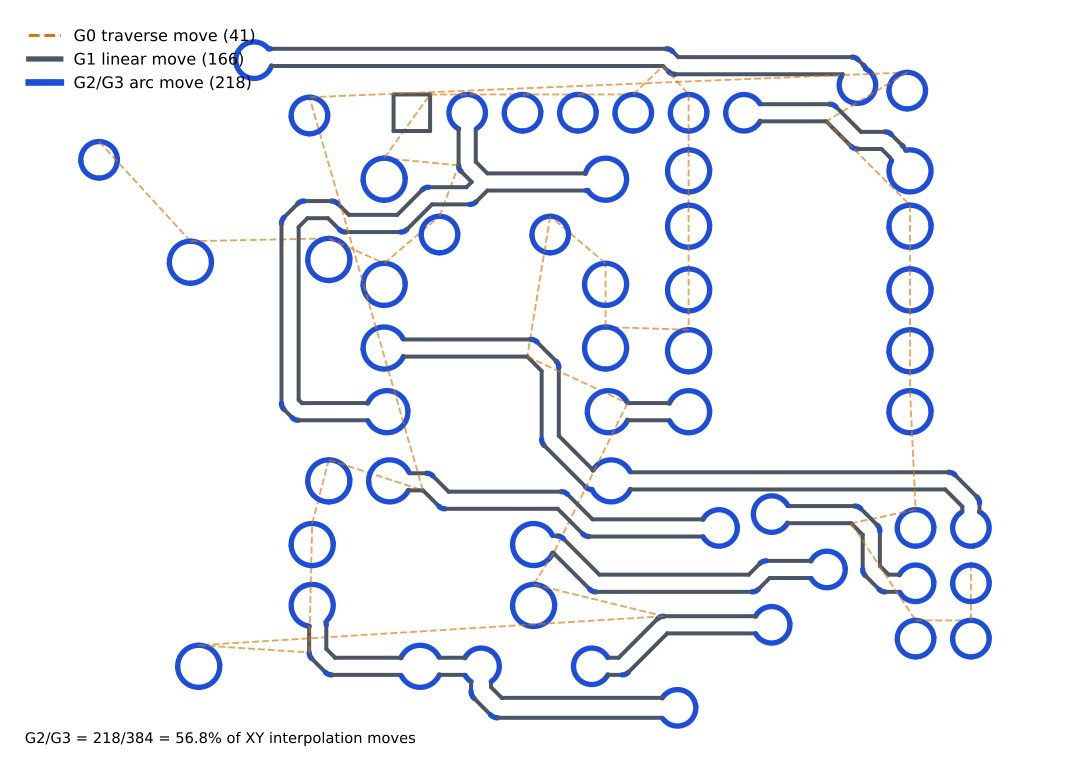
| Optimized G1/G2/G3 output | Detect suitable circular geometry automatically and generate optimized toolpaths using G1 linear moves and G2/G3 circular arcs. Depending on the design, isolation programs can contain a substantial number of circular commands. |
| Tool assignment | Assign separate tools and parameters to isolation, rubout, drilling, cutting and masking-drill operations. |
| Peck/step mode | Apply stepped-depth machining when a peck step is specified for isolation routing, copper rubout, drilling, contour cutting and masking drilling. |
| Text and graphical input | |
| PhCNC Printer Input | Send graphical output directly to PhCNC from virtually any Windows application capable of printing, using the PhCNC Printer Windows driver. Printer input can be interpreted as Engraving, Gerber Positive or Gerber Negative. |
| Raster Text & Images | Create formatted text using Windows fonts and insert images with the built-in text and image editor. The resulting graphics are inserted into the project as an independent object. |
| Vector Text | Insert true vector text directly at the mouse position using the built-in vector font. Vector text is created as an independent project object and can be moved, rotated, copied, cloned and grouped with other objects. |
| Drilling, cutting and engraving | |
| Drilling | Generate standard PCB drilling operations from Excellon and project data. |
| Routed holes | Machine holes with a router bit instead of a drill bit when required. |
| Contour cutting | Generate compensated internal and external cutting contours. |
| Masking drilling | Generate masking-related drilling operations. |
| Verification and output | |
| G-code generation | Generate production G-code from the configured CAM operations. |
| Simulation | Preview and simulate the resulting G-code before export or machining. |
| Production export | Export production files when the product is licensed. |
PhCNC provides both printer-based graphical input and native vector-text insertion as separate CAM workflows.
Compare PhCNC LSSE, FlatCAM and CopperCAM for PCB milling workflows.
Native circular interpolation is preserved in production G-code instead of being replaced by unnecessary short line segments.
PhCNC calculates machining toolpaths directly from Gerber geometry. Circular portions of the calculated toolpath are automatically detected and preserved in the exported G-code as native G2/G3 arc commands instead of being approximated by sequences of short G1 line segments.
This produces compact, geometrically accurate G-code and allows the CNC controller to execute circular motion using its native arc interpolation.
The percentage covers G1/G2/G3 XY interpolation moves in this example. G0 traverse moves are excluded.
Unlike PhCNC LSSE and PhCNC LSSE HD, PhCNC executes machining jobs and manages compatible PhCNC-based machine hardware.
| CNC capability | Availability | Description |
|---|---|---|
| G-code and PhCNC jobs | All models | Execute industry-standard G and M code programs and PhCNC project/job files. |
| PhCNC44x controller integration | PhCNC44x-equipped systems | Integrated communication and machine control through the compatible PhCNC44x CNC controller. |
| PhACdrive spindle integration | Configured systems | Integrated control of compatible PhACdrive AC/BLDC spindle drives. |
| PhSTdrive stepper integration | Configured systems | Integrated management of compatible PhSTdrive intelligent stepper drives. |
| Device firmware management | Compatible devices | Install and manage the corresponding controller, spindle-drive and stepper-drive firmware supplied with the PhCNC control system. |
| Tool change | Model dependent | Automatic tool change and calibration, or manual tool change with automatic calibration, according to the machine configuration. |
| Batch program execution | ATC models | Execute all generated programs for the selected top or bottom layer. |
| Fiducial registration | All models | Position projects and align top and bottom PCB layers. |
| Camera-assisted inspection | Model dependent | Camera or microscope positioning, measurement and inspection when the machine is equipped with the required hardware. |
| Automatic fiducial registration | All models | Fully automatic, assisted and manual fiducial-registration workflows. |
| Spindle and vacuum control | All models | Program-controlled start and stop with manual override where supported. |
| Runtime feed-rate control | All models | Program-controlled feed rate with manual override. |
| Spindle-speed control | All models | Program-controlled spindle speed with manual override. |
| Machine-specific peripherals | Model dependent | Control supported peripherals and automation according to the installed machine configuration. |
PhCNC communicates with the machine-control components and manages the corresponding firmware supplied for the configured system.
CNC motion-controller communication and coordinated machine operation for compatible PhCNC44x-equipped systems.
Integrated control of compatible TELENET AC/BLDC spindle drives.
Integrated management of compatible intelligent stepper drives and axis configuration.
Available positioning functions depend on the machine configuration.
The 32-bit and 64-bit builds provide the same principal workflow. PhCNC64 can address additional memory for large and complex projects, and both builds use parallel processing where applicable.
Scan the QR code or use the product-page address.
https://telenet-eu.com/PhCNC.php
Transfer the currently open PCB directly from KiCad, Altium Designer, EasyEDA Pro Desktop, OrCAD X / Allegro, Autodesk Fusion, CADSTAR, DipTrace or Siemens PADS Pro Layout using the CAD system's native ODB++ exporter. 8 PCB CAD systems supported.
Learn more about ODB++ Bridge →